Bedding · Bedroom Planning
Standard Bed Sizes Explained: Measurements, Frames, and Fit
A bed is a large object with a deceptively small label. “Queen” or “king” may sound definitive, but mattress dimensions vary by region and sometimes by manufacturer. Measure the mattress, the frame, and the route into the room before you buy—and leave enough space around the bed for daily life.
Choosing a bed size is part comfort decision, part room-planning exercise. A mattress must fit its frame without crowding or excessive movement; sheets need to match its exact dimensions; and the finished bed must leave usable space for doors, drawers, and bedside access. A few inches can change whether a room feels considered or congested.
The familiar names are useful shorthand, not universal measurements. North American queen and king sizes differ from similarly named sizes in the United Kingdom, while product listings may round dimensions or describe a frame’s overall footprint instead of its mattress opening. This guide compares common sizes, explains how to check platform bed frames, and offers a practical method for planning a purchase.
Mattress size at a glance
The measurements below are common reference dimensions, not a guarantee that every product carrying the same name will match precisely. North American mattress sizes are usually listed in inches; UK sizes are typically listed in centimetres. Always verify the manufacturer’s stated dimensions before ordering a mattress, frame, or bedding.
| Size | Typical dimensions | Often suited to |
|---|---|---|
| Twin | 38 × 75 in (about 97 × 191 cm) | Children, compact rooms, and single sleepers who do not need extra length |
| Twin XL | 38 × 80 in (about 97 × 203 cm) | Taller single sleepers and rooms that can accommodate additional length |
| Full / Double | 54 × 75 in (about 137 × 191 cm) | Single sleepers wanting more width, or smaller guest rooms |
| Queen | 60 × 80 in (about 152 × 203 cm) | Many couples and individuals who value extra sleeping space |
| King | 76 × 80 in (about 193 × 203 cm) | Couples seeking generous width, where room dimensions allow |
| California King | 72 × 84 in (about 183 × 213 cm) | Taller sleepers needing more length than a standard king provides |
| Size | Typical dimensions | Important note |
|---|---|---|
| Single | 90 × 190 cm (about 35 × 75 in) | Check length carefully; some ranges include longer options. |
| Small double | 120 × 190 cm (about 47 × 75 in) | Also called a three-quarter size by some retailers. |
| Double | 135 × 190 cm (about 53 × 75 in) | Not the same dimensions as a North American full mattress. |
| King | 150 × 200 cm (about 59 × 79 in) | Close in width to a North American queen, but not identical. |
| Super king | 180 × 200 cm (about 71 × 79 in) | A broad mattress; confirm that the bedroom and frame can accommodate it. |
Why bed-size names can be misleading
Size names are regional conventions, not a single international standard. A “king” in one market may be narrower, shorter, or both than a “king” elsewhere. Even within a market, specialist, antique, custom, or imported mattresses may follow different dimensions. When purchasing across borders, treat the name as a clue and the measurement as the specification.
Terminology can also blur the distinction between a mattress and a bed. Retailers may use “bed size” to mean the mattress size the bed is designed to hold, while a frame’s outside dimensions include its rails, headboard, footboard, or decorative edges. A mattress described as 60 by 80 inches does not imply that the assembled frame occupies exactly 60 by 80 inches on the floor.
There may be variation in the stated dimensions themselves. A listing can round metric conversions, and a made-to-order mattress may have different tolerances from a mass-produced one. If the fit is close, contact the seller or manufacturer for the actual measurements and recommended frame clearance instead of relying on the label alone.
Mattress measurements versus frame measurements
For a platform bed, the key measurement is the usable interior opening: the length and width of the space where the mattress rests. Compare those dimensions with the mattress manufacturer’s specifications. A frame that is too tight can make installation difficult or press against the mattress; one that is too generous can allow unwanted shifting. Follow the frame maker’s guidance on any intended clearance.
Then check the outside footprint. A substantial headboard or wide side rails can make a frame considerably larger than the mattress it supports. This matters in a small bedroom, where the frame’s extra width may narrow a walkway or prevent a closet door from opening. Record both sets of dimensions: the interior mattress opening and the total floor space occupied by the assembled bed.
Platform designs vary. Some use a solid deck, others a slatted base, and some have a perimeter ledge around the mattress. Slats need to be compatible with the mattress manufacturer’s support requirements, including any limits on spacing. Do not assume that a bed frame is suitable merely because its nominal size matches the mattress name.
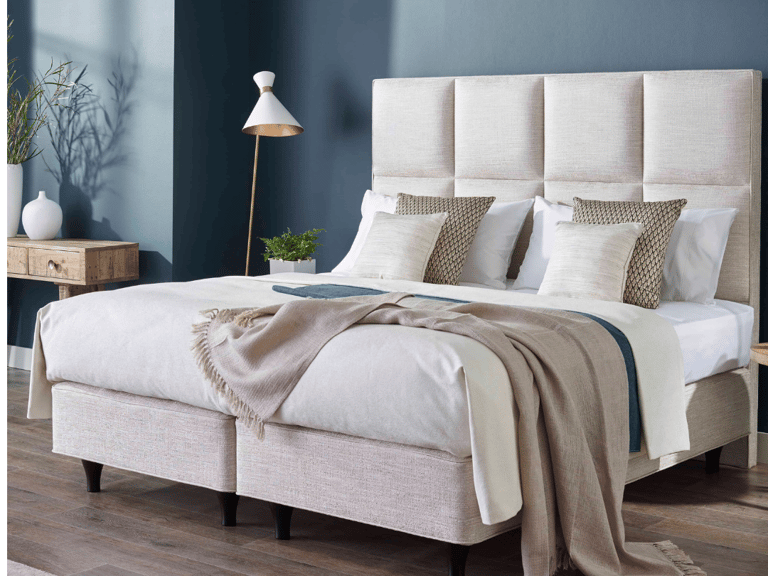
For upholstered beds, account for the thickness of padded rails and headboards. A bed can appear compact in a product title but take up more room once assembled. With a frame that includes a footboard, also consider whether it will interfere with a bench, a door swing, or movement at the foot of the bed.
Construction and mattress height affect the finished sleeping surface, too. Mattress thickness, foundation or slats, and frame height combine to determine how high the top of the bed sits. That measurement is separate from mattress width and length, but it influences ease of getting in and out, the appearance of the room, and whether fitted sheets have enough pocket depth.
How to measure a room before choosing a size
Begin with a simple floor plan. Measure the room’s length and width, then note the position and swing of every door, closet, window, radiator, and other fixed feature. Sketch the bed in the intended location using the frame’s outside dimensions—not just the mattress measurements. Paper, painter’s tape, or a basic digital floor plan can help reveal conflicts before furniture arrives.
Walkways matter as much as the bed itself. Leave enough room to get into bed, change sheets, open drawers, and pass without turning sideways. There is no one clearance that works for every room or household; the right amount depends on door locations, mobility needs, furniture, and how the space is used. A layout that technically fits may still feel awkward if access is pinched on both sides.
Consider the rest of the bedroom before moving up a size. Bedside tables, lamps, dressers, chairs, and storage all occupy real floor area. Mark their approximate footprints on your plan, and check that drawers can open fully. If two people will share the bed, make sure each has practical access rather than assuming the mattress width alone settles the question.
Think vertically as well as horizontally. A tall headboard can cover a window, sit awkwardly beneath a sloped ceiling, or compete with wall-mounted lights. Check the frame’s headboard height and the height of nearby outlets or switches. In rooms with low ceilings, a high footboard can make the bed feel visually imposing even if its floor footprint is manageable.
Plan for delivery: doors, stairs, and turns
A mattress that fits the bedroom may still be difficult to get there. Measure the front entrance, interior doorways, hallways, staircases, landings, and any tight corners along the delivery route. Note the narrowest clear width and the height of low ceilings or door frames. Measure with doors open and account for handles, banisters, and other obstacles.
Frames introduce a different delivery challenge. A bed may arrive in multiple pieces, but long rails or a one-piece headboard can be difficult to turn through a narrow passage. Check package dimensions and assembly instructions before ordering, especially for stair access. Ask the seller what is delivered, whether assembly is included, and what happens if the items cannot pass through the route.
Do not assume a mattress can be bent or folded to solve an access problem. Some mattresses are designed for particular handling, while others should not be flexed beyond the maker’s instructions. Confirm delivery requirements in advance and be clear about stairs, elevators, and unusual access restrictions.
Bedding fit is part of bed fit
Sheets, mattress protectors, and duvet covers are sized according to their own conventions. A fitted sheet must accommodate the mattress length and width as well as its depth. Measure from the bottom to the top of the mattress, including any topper that will remain in place, and compare that total with the sheet’s pocket depth. A sheet that is too shallow may pull loose; one with excess fabric can bunch beneath the sleeper.
Flat sheets and duvet covers do not need to mirror mattress dimensions exactly, because they are designed to drape or enclose a comforter. Still, a change in mattress size can affect how much coverage looks balanced. Check the finished dimensions, not only the size name, when coordinating bedding from different brands or countries.
Pillows and pillowcases also use regional size labels. Standard, queen, and king pillow names are not necessarily interchangeable between markets. If a coordinated set matters, verify the dimensions of each component and confirm whether pillowcases are included. A well-fitted bed is a system: mattress, frame, protector, sheets, comforter, and pillows all need to work together.
Choosing among common sizes
A twin can preserve valuable floor space in a child’s room, a narrow guest room, or a compact apartment. Twin XL adds length without adding width, making it a useful option when a single sleeper needs more room from head to toe. Before selecting either, compare the dimensions with the room and the intended bedding supply.
A full or double offers more width for one person than a twin, but two adults may find it restrictive for regular use. A queen is a frequent compromise: it provides more width than a full and more length than a twin or full in North American sizing. The best choice depends on the sleepers’ preferences, their movement during the night, and the furniture the room must hold.
A king gives two sleepers more side-to-side space, while a California king trades some width for additional length. That distinction is easy to miss: California king is longer, but narrower, than a standard North American king. Taller sleepers should compare the actual mattress length; couples prioritizing width may prefer a standard king if their room can accommodate it.
When choosing, consider more than who sleeps in the bed. Children or pets who sometimes join, a shared reading habit, a need for clear movement around the mattress, and future room changes may all influence the decision. A larger mattress is not automatically a better fit if it leaves too little usable space around it.
A frame is also a design and support decision
Once the mattress size is settled, look at how the frame supports it and how its shape affects the room. A simple platform may have a smaller visual profile than a bed with a prominent headboard and footboard, though the product’s measured footprint is the reliable guide. Check the construction details, support surface, and compatibility instructions before deciding.
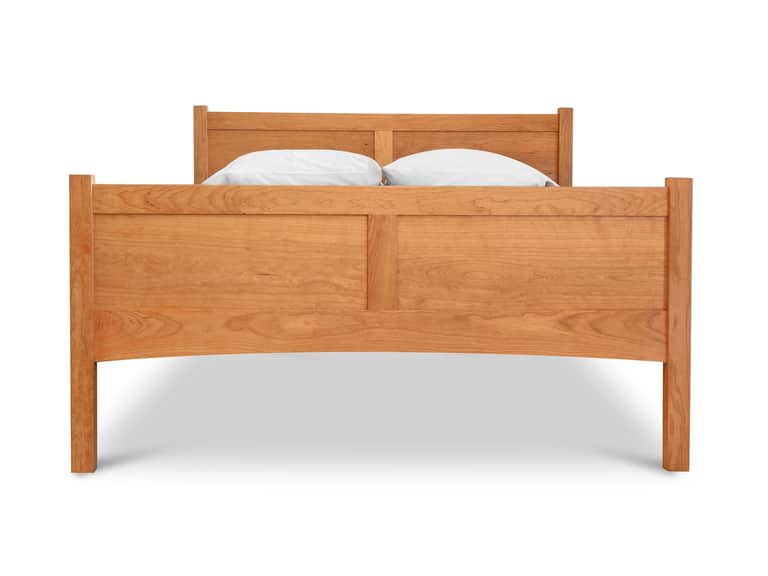
For example, the Essex High Footboard Bed is a solid-hardwood panel bed with a high footboard. Its materials and substantial design may suit a room where a more defined bed silhouette is wanted, but shoppers should confirm the available size, interior mattress opening, and outside dimensions with the seller. The name of a frame does not replace those measurements.
Bed height deserves deliberate attention. A low platform can create a grounded look and may make a room feel more open, while a taller frame can provide storage or make standing up easier for some sleepers. Compare the assembled frame height with the mattress thickness and any foundation. The result—not the frame alone—is the height you experience every day.
A reliable measurement checklist
- Measure the mattress: Record its actual width, length, and depth, rather than relying only on “queen” or “king.”
- Check the frame opening: Confirm the usable interior dimensions and the manufacturer’s recommended mattress fit.
- Record the outside footprint: Include rails, headboard, footboard, and any protruding components.
- Map the room: Mark doors, closets, windows, fixed objects, furniture, and practical walking routes.
- Measure the delivery path: Check entrances, halls, stairs, landings, elevators, and turns for both packages and assembled components.
- Verify bedding: Match fitted-sheet depth and pillowcase dimensions to the mattress and pillows you own.
- Confirm before purchase: Ask the retailer about regional sizing, tolerances, assembly, and returns if the measurements are unclear.
Measure twice; sleep more easily
Standard bed sizes make comparisons easier, but the label is only the start. Regional conventions, manufacturer variation, frame construction, mattress depth, and delivery access all affect whether a bed works in practice. The most dependable approach is straightforward: compare exact mattress dimensions with the frame’s interior opening, plan around the frame’s full footprint, and measure the journey from the entrance to the bedroom.
That small investment of time can prevent a familiar chain of frustrations—a frame that will not turn upstairs, a mattress that shifts on its platform, a fitted sheet that will not stay put, or a walkway narrowed by an oversized headboard. In bedroom planning, precision is not fussiness. It is what allows comfort, access, and the room itself to fit together.